
Most commercial soundproofing projects focus on walls, ceilings, and acoustic panels. Doors tend to get treated as an afterthought. In most buildings, that oversight quietly undermines everything else in the acoustic treatment plan.
A soundproof door sweep addresses the gap at the base of a door that standard construction almost always leaves open. At Sound Management Group, we include door sealing as a core part of every noise control assessment. The performance of even the most expensive wall assembly can be cut in half by a single unsealed door.
Why Soundproof Door Sweeps Matter More Than Most People Expect
Sound behaves like air or water; it finds any available opening and passes through. The floor gap is particularly problematic in commercial settings. A standard commercial door undercut (the gap between the door bottom and the floor) can measure up to 3/4 of an inch. In a hallway with foot traffic, HVAC noise, and open-plan office chatter on the other side, that gap operates acoustically like a small open window.
A properly specified soundproof door seal closes this pathway. The difference in measured performance before and after is often significant enough to hear immediately.
Standard Sweeps Vs. Automatic Door Bottoms
Not all door seal products perform the same way in commercial environments. Understanding the options helps with specification.
- Standard door sweeps: A fixed rubber or silicone strip attached to the base of the door. These make contact with the floor at all times, which works on level surfaces but often fails to maintain a consistent seal on uneven flooring. They also create drag on the door, which accelerates wear on both the sweep and the floor surface.
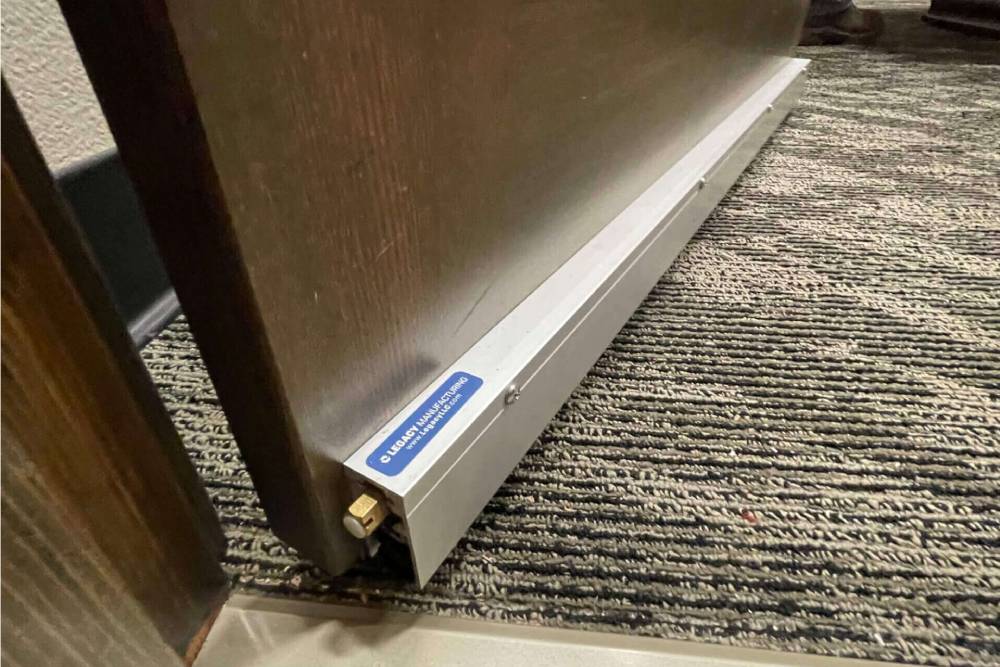
- Automatic door bottoms: The commercial-grade solution. A flat spring mechanism activates as the door closes, dropping a neoprene seal against the threshold in a scissor-like motion. The seal retracts automatically as the door opens. This eliminates drag, maintains a consistent seal regardless of minor floor variations, and delivers better long-term performance than a static sweep.
- Perimeter seals: Address the sides and top of the door frame. A full perimeter seal kit paired with an automatic door bottom can add 8 to 10 STC points to a solid-core door assembly. On its own, a sealed frame turns a marginal door into a functional acoustic barrier.
- Threshold seals: Complete the assembly at floor level, particularly important where the floor surface changes or where moisture resistance is needed alongside acoustic performance.
Automatic door bottoms are available in surface-mounted, semi-mortised, and fully mortised configurations. Surface-mounted units can be installed without removing the door from its hinges, making them practical for retrofits in occupied commercial buildings.
A Simple Test that Reveals the Problem Immediately
After installing any door seal, a basic flashlight test tells you whether it's working. Stand on the latch side of a closed door in a darkened room and shine a flashlight around the full perimeter. Any light visible from the other side indicates a gap through which sound can pass.
A secondary check involves closing the door on a strip of paper at several points around the frame. Gentle resistance when pulling the paper out confirms the seal is making proper contact. No resistance means the seal is not compressing and the gap remains open.
Sealing Doors Is a Precision Detail, Not an Afterthought
At Sound Management Group, our architectural door seals are manufactured in the USA and available in a range of profiles and materials. Door sealing is one component of a complete noise control approach. It works best when it is specified as part of a broader system that includes wall performance, acoustic treatment, and sound masking.
Noise or speech privacy issues in commercial spaces often stem from overlooked details, with door gaps among the first areas to check. Reach out to our team for a site assessment to identify where sound is getting through and how to address it.

