
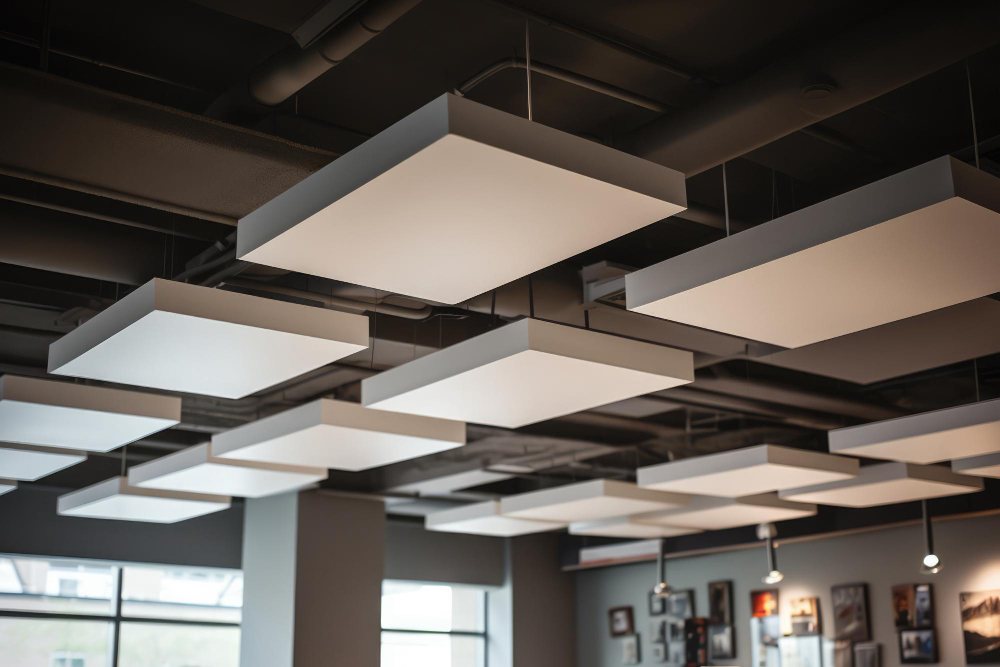
Some of the most persistent noise problems in commercial and professional spaces have nothing to do with the walls. Sound travels upward, reflects off the ceiling, and comes back down carrying extra reverberation that makes the room louder, conversations harder to follow, and concentration more difficult to hold.
Acoustic ceiling clouds address this directly by positioning absorption exactly where overhead sound energy travels, intercepting it before it can reflect back into the room. At Sound Management Group, we treat ceiling treatment as a design decision as much as an acoustic one. The two goals are not as separate as people often assume.
What Acoustic Ceiling Clouds Are and Why They Work
Ceiling clouds are horizontal or vertical acoustic panels suspended from the ceiling above key activity zones. Unlike wall-mounted panels, clouds hang in open space, which means both faces of the panel are exposed to sound.
Sound coming up from below is absorbed on the underside. Sound reflecting down from the ceiling structure above is absorbed on the top face. This two-sided exposure makes them more efficient per unit of surface area than a wall panel of equivalent size.
The result is a noticeable reduction in reverberation time: the time it takes for sound to continue bouncing around the room after the source stops. In open offices, restaurants, conference rooms, and studios, high reverberation times make speech harder to understand and force people to raise their voices, which compounds the noise problem further.
Echo-reduction panels like ceiling clouds are particularly valuable in spaces where wall treatment is limited by windows, shelving, artwork, or the architectural character of the space.
Designing Clouds that Look Like They Belong
A ceiling cloud that looks like an afterthought undermines the space it is meant to improve. The most effective installations treat the clouds as a deliberate design layer. It’s one that contributes to the room's visual identity alongside its acoustic function.
Here is what shapes a well-designed cloud installation:
-
Size and proportion: Clouds should be sized relative to the zone they serve. A cloud positioned above a conference table, for instance, works best when its footprint roughly mirrors the table below it.
- Suspension height: Lower clouds increase absorption effectiveness. A cloud hung too close to the ceiling loses the air gap that enables two-sided absorption.
- Spacing and arrangement: Multiple clouds arranged in a pattern (staggered, offset, or in a deliberate grid) perform better than a single large panel and create more visual interest.
- Shape: Rectangular clouds are the standard, but irregular shapes, angled panels, and custom geometries are all acoustically viable and can make a significant design statement.
- Fabric and finish: Fabric-wrapped clouds come in a wide range of colors and textures. Custom-printed options, like our Acoustic Impressions Digital Prints, deliver full graphic imagery across the panel face without compromising absorption performance.
The key is treating cloud placement as part of the interior design process from the start rather than as a correction applied after the fact.
The Detail Work Is What Makes It Perform
A ceiling cloud installation that performs well comes down to specifics: the right suspension hardware, an accurate layout relative to the activity zones below, the correct panel depth for the targeted frequencies, and a fabric or finish that holds up in the environment over time.
At Sound Management Group, we survey every space before specifying a cloud layout. The ceiling height, room geometry, existing surface materials, and how the space is used all shape what the installation needs to look like and perform. If you are working on a space where overhead noise is affecting the environment, reach out to our team today.

