
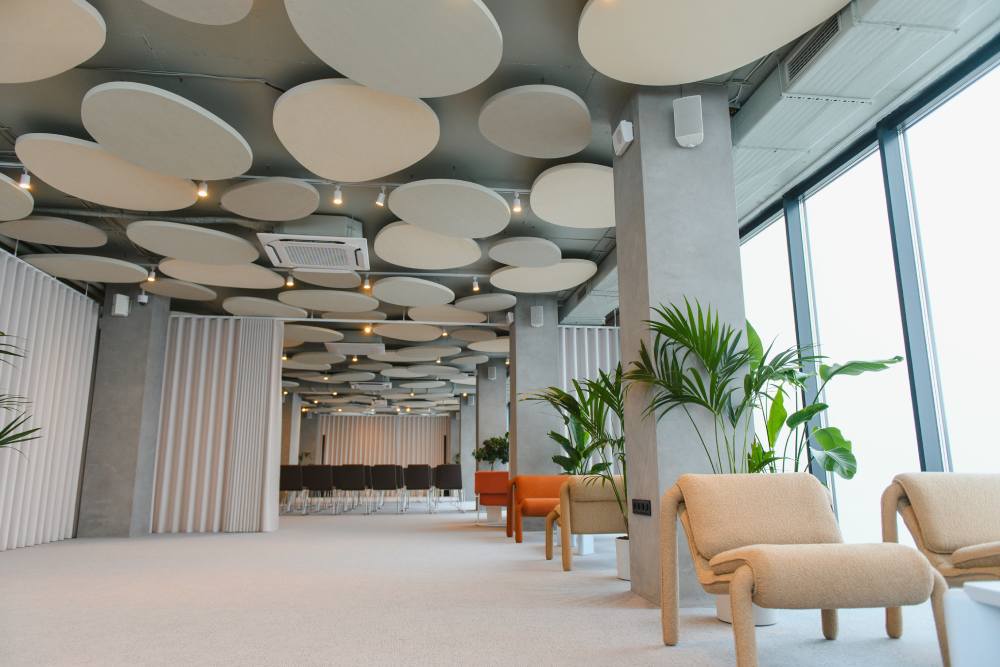
If you are asking, "How many acoustic panels do I need for an office room?", you are not alone. Commercial property managers and business owners often search for the right balance between effective noise control and refined interior design. The answer depends on room size, layout, surface materials, and how the space functions each day.
How Many Acoustic Panels Do I Need in a Commercial Office
Most office environments benefit from treating approximately fifteen to twenty-five percent of the combined wall and ceiling surfaces. This range reduces excessive reverberation while preserving a natural sound profile that supports speech clarity.
Final quantities vary based on daily use. A private executive office typically requires less coverage than a large conference room or open collaboration area. Spaces with higher occupancy and ongoing conversation demand carefully distributed absorption to maintain control.
Room Size, Ceiling Height, and Surface Materials Matter
Square footage plays a direct role in acoustic treatment planning. Larger rooms with high ceilings allow sound waves to travel farther, increasing echo and speech overlap. In these environments, panel placement must account for both horizontal and vertical reflections.
Hard materials such as glass, concrete, and metal intensify reflection issues. An office filled with windows and exposed ceilings will need more absorption than a carpeted space with soft furnishings.
Placement Strategy is Just as Important as Quantity
When calculating coverage, panel placement can influence performance as much as panel count. Thoughtfully installed wall and ceiling panels interrupt reflection paths before sound builds into distracting reverberation. This strategy creates a more controlled acoustic environment without overloading the room visually.
Addressing first reflection points near conference tables, shared desks, and presentation walls can significantly improve clarity. Strategic distribution often produces measurable gains without covering every surface. This balanced approach maintains a professional aesthetic while delivering meaningful noise reduction.
Different Office Types Require Different Coverage Levels
An enclosed office used by one or two employees typically requires modest treatment. A boardroom with video conferencing technology demands more aggressive sound control to prevent speech distortion. The type of work being performed directly shapes acoustic expectations.
Open-plan environments often combine absorption with sound masking systems. Sound Shadow® Sound Masking Systems integrate smoothly with absorptive panels to manage conversational privacy.
Together, these solutions create a balanced sound field that reduces distractions across larger commercial footprints.
Calculating Coverage Percentage for Real World Conditions
Many professionals begin by calculating total wall and ceiling square footage. From there, applying a 15 to 25 percent treatment ratio gives a starting estimate for panel quantity. This method offers a practical baseline before refining placement details.
Acoustic modeling can refine these projections further. Sound Management Group uses detailed design analysis and custom manufacturing capabilities to tailor panel dimensions and finishes. This process accounts for layout irregularities, ceiling treatments, and architectural features unique to each facility.
Balancing Performance with Aesthetic and Brand Identity
Acoustic treatment does not have to compromise visual appeal. Products such as Eco Absorb® Acoustical Treatments and Sound Delete® Acoustical Treatments are manufactured in the United States and designed for commercial interiors. They blend performance with architectural integration.
For offices that prioritize branding, Acoustic Impressions® Digital Prints transform panels into visual design elements. Logos, environmental graphics, or artwork can be incorporated directly into absorptive materials. This approach turns acoustic control into an extension of corporate identity rather than an afterthought.
When to Combine Panels with Sound Masking Systems
In many commercial offices, absorption alone does not address every acoustic concern. While panels reduce reverberation, they do not control speech privacy in open work environments. Integrating Sound Shadow® Sound Masking Systems introduces a consistent ambient sound layer that minimizes conversational distractions.
This combination is especially effective in open plan offices and multi-workstation environments. Absorption manages reflected sound energy, while masking reduces intelligibility across distances.
Creating an Effective Office Acoustic Plan
There is no universal number that answers "How many acoustic panels do I need for every office?" The right quantity emerges from careful measurement, thoughtful placement, and alignment with how the space functions daily. A well-planned system addresses reverberation, speech clarity, and overall workplace comfort.
With 42 years of experience and national installation capabilities across New Jersey, California, and Louisiana, Sound Management Group approaches each project as a complete solution. From survey and design through custom manufacturing and installation, every stage is coordinated to deliver measurable acoustic improvement.
Ready to Improve Your Office Acoustics?
At Sound Management Group, we design and install fully integrated acoustic systems tailored to commercial environments nationwide. Contact us to schedule a professional evaluation for your office space.

