
Pickleball is America's fastest-growing sport. Courts are popping up in residential neighborhoods, recreation centers, HOAs, and private clubs. With them come complaints that, in some cases, have led to restricted hours, fines, and court closures.
Pickleball soundproofing addresses the problem before it reaches that point. Understanding why the sport generates so much noise is the first step toward choosing a solution that actually works.
Why Pickleball Noise Needs Its Own Mitigation Strategy
Pickleball produces a distinctive, sharp popping sound when the solid paddle strikes the hard plastic ball. At 100 feet from a court, that impact registers around 70 dBA. It’s significantly louder than a typical tennis rally at 40 dBA.
What makes it worse is the sound itself. The pop falls in the mid-frequency range, close to the frequency of human speech, which means the human brain actively picks it up and registers it as intrusive. Add multiple courts operating at the same time, plus players cheering and calling out scores, and the cumulative noise level rises fast.
The surface under the court matters too. Concrete and asphalt (the base material on most repurposed tennis courts) amplify the ball's bounce and project sound outward. There is also the impulsive nature of the noise to consider: short, sharp bursts of sound are more psychologically irritating to people nearby.
At Sound Management Group, our pickleball soundproofing solutions are designed around these specific acoustic characteristics. A generic barrier approach rarely performs well against a noise profile this distinct.
Pickleball Sound Barrier Options for Outdoor Courts
Outdoor courts are the most common source of noise complaints. Sound travels freely in open air, and without barriers, the pop of a paddle can carry well beyond 250 feet. Surrounding sound-blocking material can reduce noise by up to 12 decibels.
The most practical outdoor barrier options include:
- Mass-loaded vinyl (MLV) panels: A dense, flexible material mounted to existing fencing that blocks direct sound transmission without requiring structural changes to the court.
- Composite noise barrier panels: These combine a quilted fiberglass absorber layer with MLV, adding both blocking and absorption; best used when wrapping three to four sides of a court to address reflections as well as transmission.
- Acoustic fencing wraps: More accessible for existing courts with chain link fencing. They are more effective than mesh windscreens, which are designed for airflow rather than noise control.
Court orientation and placement also play a significant role in outdoor noise management. More sound travels from the ends of a court than from the sides, so aligning courts with that in mind. Positioning them at least 500 feet from residential boundaries helps reduce the treatment load on any barrier system.
Pickleball Noise Mitigation for Indoor Facilities
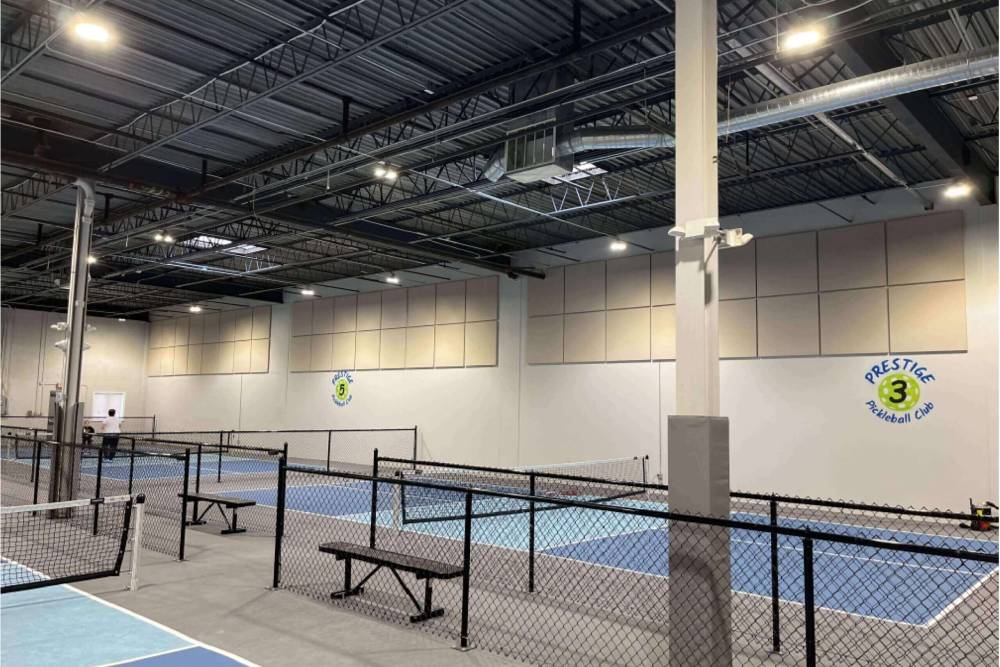
Indoor courts create a different set of problems. Sound has nowhere to go, so it bounces off hard walls, floors, and ceilings, building into a reverberant environment that makes communication between players difficult and creates fatigue over longer sessions. The same hard surfaces that make outdoor courts loud create echo chambers indoors.
Effective indoor treatment typically combines overhead baffles or suspended acoustic clouds to manage ceiling reflections with wall-mounted panels to reduce lateral sound buildup. The goal is to bring reverberation down to a level where players can hear each other clearly without the room working against them.
Our acoustical design and consultation service covers exactly this kind of space-specific planning. We can map out where sound is originating and reflecting before recommending a treatment layout.
Build a Quieter Court Before the Complaints Start
The most cost-effective time to address pickleball noise is before a court opens, not after the first complaint arrives. Retrofitting barriers and acoustic treatment onto an existing facility works, but it costs more and takes longer than designing it in from the start.
Connect with our team for a site consultation if you are planning a new facility or dealing with ongoing noise issues at an existing one.

