
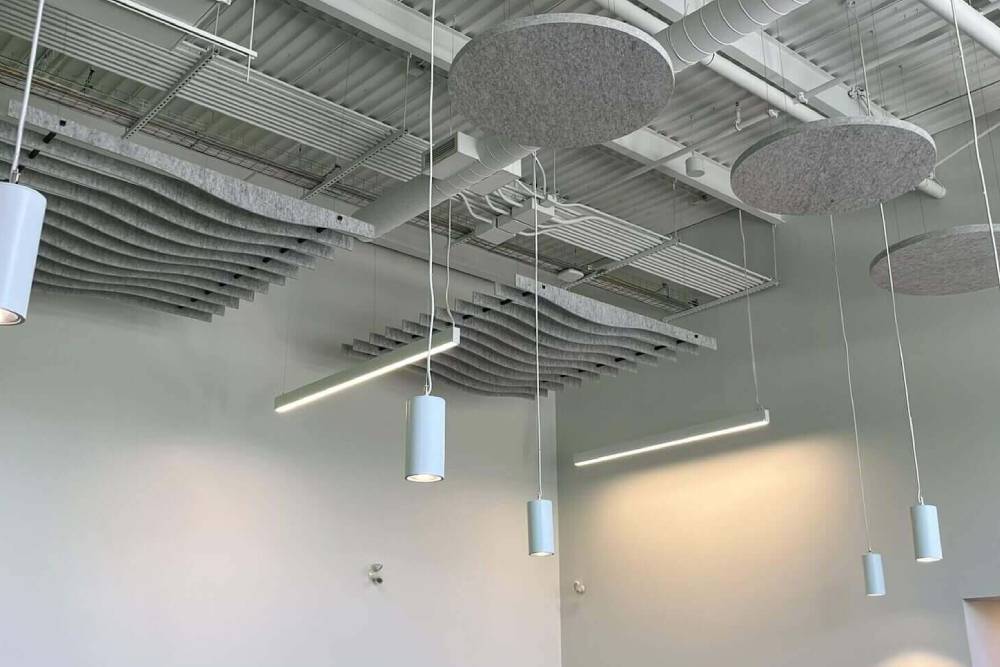
Sound travels fast, and hard ceilings give it nowhere to go but back into the room. In open offices, restaurants, schools, and healthcare facilities, reflected sound accumulates into a wall of noise that makes communication harder and comfort near impossible.
Acoustic cloud placement is one of the most effective ways to address this problem. Getting it right comes down to understanding your space before you hang a single panel.
What Acoustic Cloud Placement Does for a Space
Acoustic clouds are horizontally suspended panels that absorb sound from two directions at once. The underside catches direct sound from voices and activity below. The top face absorbs reflections bouncing off the ceiling above. This dual-surface absorption is what makes suspended clouds outperform flat ceiling tiles in many commercial settings.
The goal is not to eliminate all sound. A room with excessive absorption feels unnaturally dead and can make speech harder to follow. What you want is a balanced environment, one where conversations don't carry across an entire floor plan. Reverberation should be kept to a manageable level, and people can focus without straining to hear.
Hanging Acoustic Panels from the Ceiling: Where to Start
Placement decisions should follow the sound, not the floor plan. Start by identifying where noise originates and where it travels. In an open office, that means workstations, collaboration zones, and printer bays. In a restaurant, it's the dining floor and bar area. In a school, there are classrooms and hallways with hard walls on all sides.
A few placement principles that hold across most commercial environments:
- Position clouds above primary activity zones: desks, benching systems, meeting tables, and dining areas are the highest priority
- Stagger panels rather than lining them up in rows, since continuous straight edges can channel sound along a path instead of absorbing it
- Lower the suspension height in meeting areas where possible, bringing the cloud closer to conversation level without interfering with lighting or sprinkler systems
- Leave clearance above the panel of at least 200mm to avoid blocking HVAC diffusers
- Place higher-density clouds above noisy equipment like printers, coffee stations, or HVAC outlets
Clouds may need to be clustered rather than distributed evenly for spaces with tall ceilings like lobbies, auditoriums, and warehouses. Grouping panels over high-traffic areas delivers greater impact than scattering them across the entire ceiling.
How Coverage Area and NRC Ratings Affect Performance
Coverage does not need to be total. A 3,000-square-foot space does not need 3,000 square feet of cloud panels. The acoustic needs of the space, the NRC rating of the panels, and the existing surface materials all factor into how much coverage is needed to deliver the results you need.
NRC (Noise Reduction Coefficient) measures how much sound a material absorbs on a scale of 0.0 to 1.0. Open offices and classrooms perform best with panels rated NRC 0.90 or higher. Conference rooms and healthcare settings often target the same range due to speech privacy requirements in those environments. Reception areas and lobbies can manage well with NRC ratings between 0.60 and 0.75.
At Sound Management Group, our clouds, banners, and baffles meet high NRC performance standards across a range of commercial settings. They can be paired with wall treatments for a more complete acoustic solution where the space demands it.
Get the Sound Right from the Start
Acoustic performance is largely set at the design stage. Changing it after a space is occupied is possible, but always more disruptive and costly than planning ahead. A proper site survey identifies the specific acoustic challenges in a space and maps out a placement strategy that addresses them without overbuilding.
Enhance your space with our professional consultation services for fit-outs, renovations, and upgrades. Reach out to our team today.

