
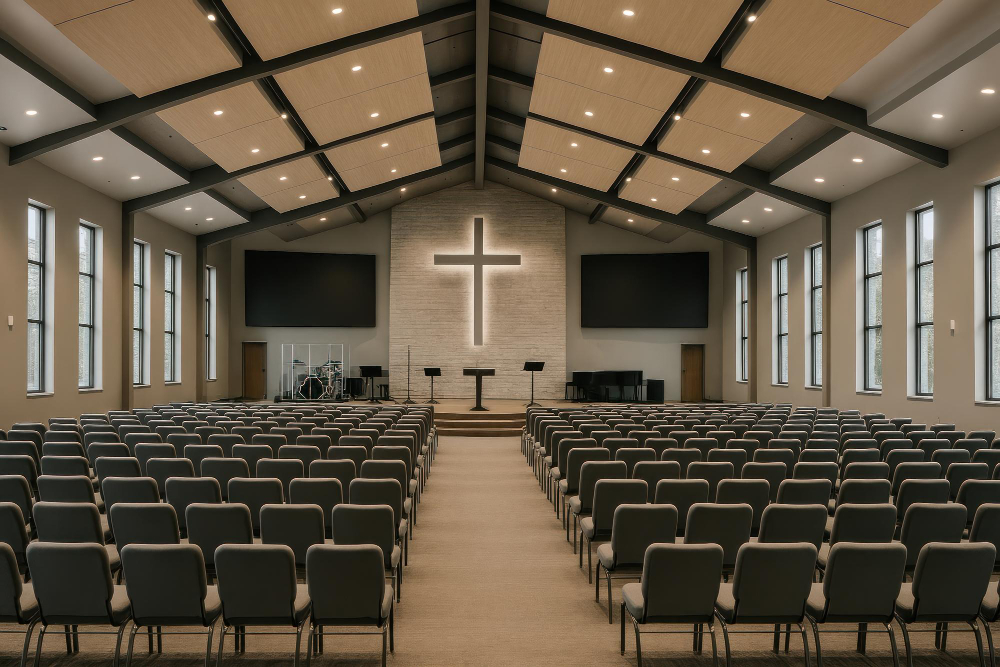
A sermon that gets lost in the room before it reaches the back row can disconnect people from the service entirely. Church sanctuaries are among the most acoustically challenging spaces to treat. The architecture that makes them beautiful is often the same reason they sound challenging.
High vaulted ceilings, hard stone or drywall surfaces, large windows, and wooden pew floors all reflect sound, creating echo, reverberation, and a general muddiness that no sound system can fully fix on its own. Church sound panels address the problem at the room level, where it actually starts.
Why Church Sound Panels Present a Unique Challenge
Most sanctuaries were designed before modern AV equipment existed. The bare surfaces and open volumes that once helped carry an unamplified voice now work against a congregation trying to follow a speaker through a PA system. Sound bounces from surface to surface, building up reverberation that smears the message and competes with the music.
The challenge in a worship space is that speech and music have different acoustic needs. Speech becomes clearer with a reduced reverberation time (RT60) closer to 0.9 to 1.0 seconds.
Traditional choral music benefits from longer reverb, typically 1.5-1.6 seconds. Contemporary praise bands with amplified instruments tend to perform better in drier rooms. Finding the right balance means working with the room's actual dimensions and surface materials.
Sound Absorbing Panels for Churches: Where to Start
Treatment should follow the distribution of sound problems. In most sanctuaries, the priority zones are:
- Rear wall and balcony front: These flat, reflective surfaces bounce sound directly back into the congregation and are typically the highest-impact areas to treat first
- Ceiling: High open ceilings accumulate sound with little to absorb it; suspended ceiling clouds or acoustic baffles hung parallel to the ceiling address this without requiring structural changes
- Stage area: Controlling sound at its source reduces the amount of echo the rest of the room has to manage; panels placed behind amplifiers and drum kits make a measurable difference
- Wall corners: Low-frequency energy produced by bass guitars and subwoofers tends to build up in corners; bass traps reduce this buildup and improve overall tonal balance
If wall space is limited, ceiling-mounted clouds serve the same absorption function as wall-mounted clouds. In spaces with high reverberation where clear speech is the main priority, diffusers can scatter sound instead of fully absorbing it. This helps maintain a sense of liveliness in the room while reducing muddiness and improving clarity.
Our church acoustic treatment and soundproofing covers how we approach worship spaces across different sizes and worship styles.
Aesthetics and Acoustics in the Same Space
One of the most common hesitations we hear from church facilities teams is the concern that acoustic treatment will compromise the look of a sanctuary they've spent years designing. The good news is that acoustic panels have evolved considerably in both form and function.
Panels are now available in custom shapes, sizes, fabric colors, and printed finishes. Art acoustic panels can carry biblical imagery, church branding, or photography that integrates naturally into the existing interior. Ceiling clouds come in configurations that complement high-vaulted architecture rather than fighting it.
The idea that you have to sacrifice aesthetics for acoustic performance is outdated. Our approach at Sound Management Group has always been built around that principle.
Acoustic Sound Panels for Churches: Don't Forget the Rest of the Building
The sanctuary gets most of the attention, but acoustic problems affect the entire building. Fellowship halls tend to have the same hard-surface issues as sanctuaries, and with more casual conversation happening in tighter groups, the noise can become fatiguing.
Classrooms, nurseries, and multipurpose rooms all benefit from tailored panel treatments. Side chapels and prayer rooms often require a quieter acoustic character than the main hall. Targeted treatment can achieve that without major construction.
A congregation that can hear, connect, and feel comfortable across the full building is one that keeps coming back.
Make Your Worship Space Sound as Good as It Looks
Acoustic treatment in a church is a functional investment in the experience your congregation has every week. Starting with a proper assessment of reverberation time and problem zones gives you a clear path forward without over-treating or wasting budget on the wrong surfaces.
Worship spaces with sound issues can benefit from a site consultation with our team to identify practical solutions. Connect with our team today.

